Why Most Morning Routines Are Cargo Culting: The Productivity Myth of Early Rising
Morning routines are often touted as the secret to productivity, but most are just cargo culting. Learn why early rising isn't a universal solution and how to design habits that actually work.

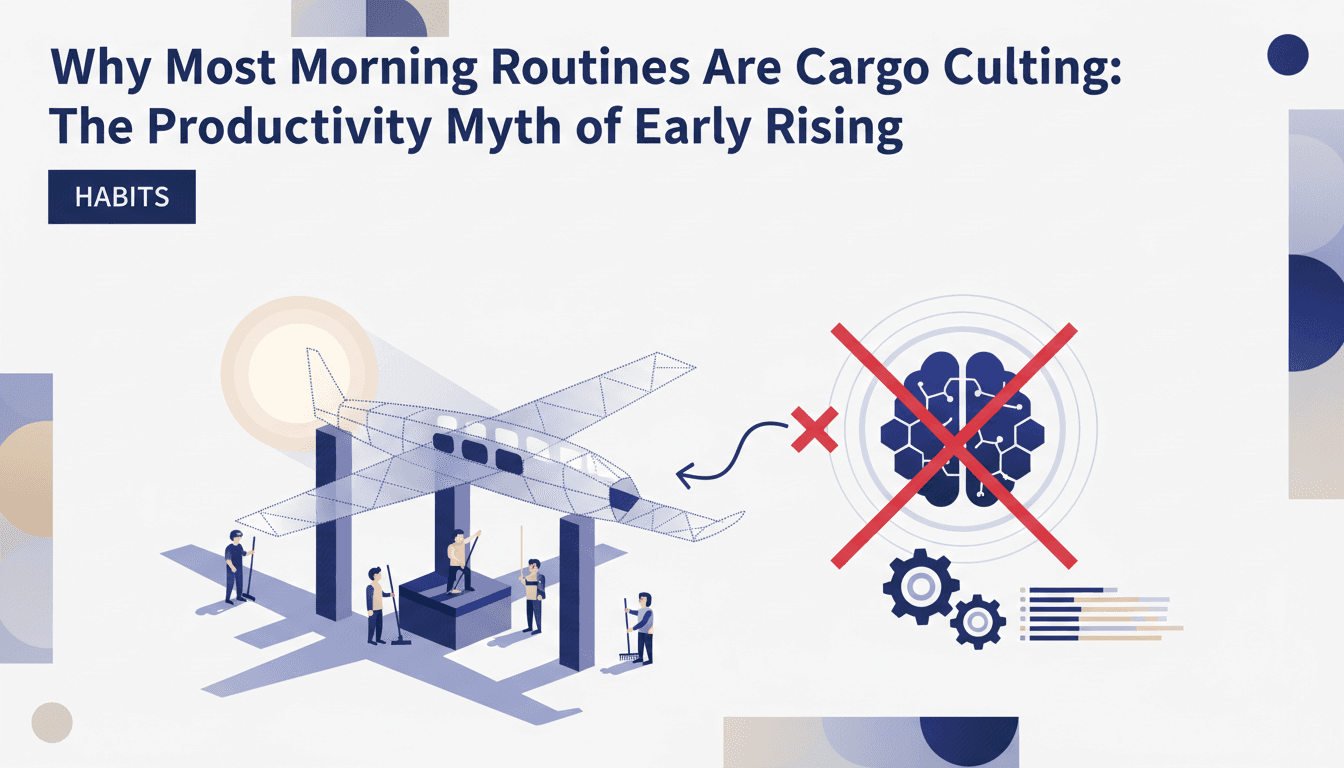
Morning routines have become a cultural obsession. From Tim Ferriss’s ice baths to Elon Musk’s 5 AM starts, we’re bombarded with rituals that promise peak productivity. But here’s the uncomfortable truth: most of these routines are cargo culting—mimicking the form of success without understanding the substance. They’re rituals without results, habits without purpose.
The problem isn’t the idea of a morning routine itself. The problem is the misapplication of habits. We see successful people wake up early, meditate, or journal, and we assume these actions cause their success. But correlation isn’t causation. What works for one person might be irrelevant—or even detrimental—for another.
The Science of Chronotypes: Why Early Rising Isn’t Universal
The first flaw in the morning routine dogma is ignoring chronotypes. Research by sleep scientist Dr. Michael Breus shows that humans have genetically determined sleep-wake cycles. Some people (larks) naturally wake up early and feel most alert in the morning. Others (owls) peak in the evening and struggle to function at dawn.
Forcing yourself to wake up at 5 AM if you’re an owl isn’t just uncomfortable—it’s counterproductive. Studies show that mismatched wake times lead to impaired cognitive performance, reduced creativity, and even long-term health risks. If your chronotype isn’t aligned with your routine, you’re fighting biology, not optimizing it.
Morning Routines as Status Signals
Another issue is the symbolic value of morning routines. Waking up early has become a badge of honor, a signal of discipline and ambition. But this symbolism often overshadows practicality. As Cal Newport argues in Deep Work, the real measure of productivity isn’t how early you wake up—it’s how effectively you use your time.
Consider this: if you’re waking up early to scroll through emails or attend low-value meetings, you’re not gaining an edge. You’re just shifting your wasted time to an earlier hour. The focus should be on high-leverage activities, not arbitrary wake-up times.
The Myth of Willpower Depletion
Many morning routines rely on the assumption that willpower is strongest in the morning. This idea stems from Roy Baumeister’s ego depletion theory, which suggests that self-control is a finite resource. However, recent research challenges this view. A meta-analysis published in Perspectives on Psychological Science found little evidence for ego depletion as a universal phenomenon.
Instead, motivation and focus are influenced by task meaning and environmental cues. If your morning routine feels like a chore, it’s unlikely to boost your productivity. You’re better off designing habits that align with your intrinsic motivations and work context.
How to Design a Morning Routine That Works
Stop copying what works for others. Start by asking: What problem am I solving? Are you struggling with focus? Procrastination? Energy levels? Your routine should address specific pain points, not generic ideals.
Here’s a framework for building a meaningful morning routine:
- Audit Your Energy: Track your energy levels throughout the day using tools like Lebenmaster. Identify when you’re most alert and creative.
- Define Your Focus: Choose one or two high-leverage tasks that align with your peak energy. This could be writing, coding, or strategic planning.
- Eliminate Friction: Remove barriers to starting your routine. Lay out your clothes, prep your workspace, or automate decisions the night before.
- Measure Progress: Use habit-tracking apps to monitor consistency. Focus on small wins—completing your routine three times a week is better than abandoning it after a month.
The Cargo Cult Trap: A Case Study
Consider Sarah, a software engineer who decided to adopt a 5 AM routine after reading about its benefits. She struggled to wake up, felt groggy all morning, and found herself procrastinating on critical tasks. After tracking her energy levels with Lebenmaster, she discovered her peak focus was actually in the late afternoon. By shifting her deep work sessions to 2 PM, she doubled her coding output and reduced errors.
Sarah’s story illustrates the danger of cargo culting. She mimicked a routine without understanding its purpose or relevance to her biology. The result was wasted effort and frustration.
Conclusion
Morning routines can be powerful, but only if they’re tailored to your unique needs. Stop chasing arbitrary wake-up times and start focusing on what actually moves the needle. Use tools like Lebenmaster to track your energy and habits, and design a routine that works for you—not someone else’s idealized version of productivity. Start your free Lebenmaster trial today and take the guesswork out of habit design.
For further reading, check out Dr. Michael Breus’s research on chronotypes and Cal Newport’s Deep Work.
A note on product references — Lebenmaster evolves continuously in response to user feedback and market conditions. Features described in this article may already have changed, been renamed, or been deprecated. Availability of specific capabilities depends on your region, subscription tier, and platform. For the current experience, start a free trial.