Why Habit Stacking Fails Most People: The Execution Gap in Atomic Habits
James Clear's habit stacking assumes spare cognitive bandwidth. Neuroscience shows why this fails for complex behaviors. A better method exists.

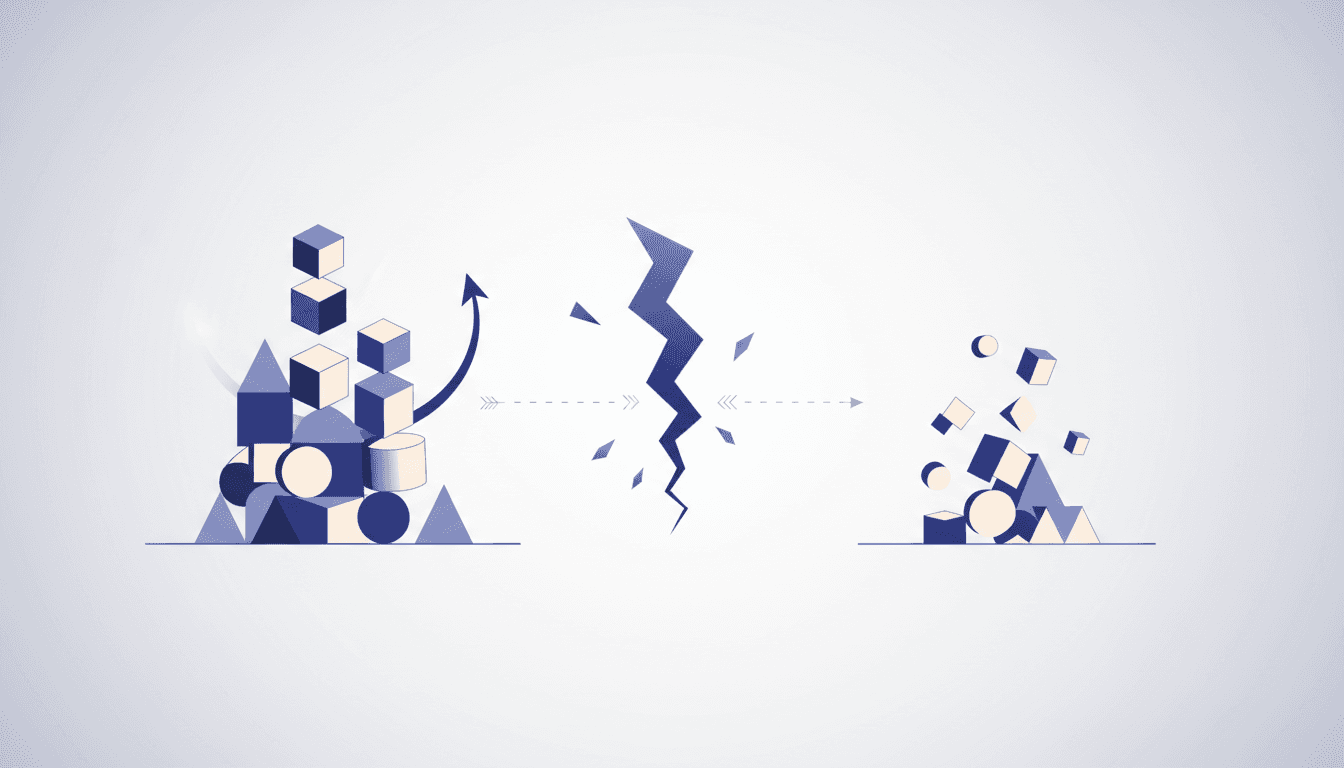
The promise of habit stacking seduces with simplicity: anchor a new behavior to an existing routine. Drink water after brushing teeth. Do squats while coffee brews. But by month's end, the water glass sits empty and the coffee pot brews alone.
This isn't failure of willpower—it's failure of cognitive architecture. Working memory maxes out at four chunks (Cowan, 2001), yet most habit stacks require five or more simultaneous operations. When brushing teeth already consumes two chunks (grip toothbrush, coordinate motion), adding water drinking overloads the system.
The Three Hidden Costs of Habit Stacking
1. Contextual interference: Research on skill acquisition (Shea & Morgan, 1979) proves behaviors learned in isolation transfer better than those learned in combination. Stacking creates parasitic dependencies—if you skip coffee, the linked squat habit dies with it.
2. Threshold neglect: BJ Fogg's Behavior Model shows actions only occur when ability exceeds the activation threshold. Stacking raises this threshold exponentially. Brushing teeth (easy) + drinking water (easy) seems viable, but the transition between them requires executive function not accounted for in atomic habit models.
3. Feedback delay: Anders Ericsson's deliberate practice research emphasizes immediate feedback as the cornerstone of skill acquisition. Stacked habits bury feedback under layers of automation. You won't notice poor squat form when focused on coffee aroma.
The Compounding Alternative: Serial Mastery
Replace horizontal stacking with vertical progression:
-
Master the anchor habit first: Achieve 90% automaticity (measured by no longer needing reminders) in the base behavior before adding anything. Use Lebenmaster's consistency tracking to quantify this.
-
Add micro-sequences: Once brushing reaches automaticity, insert a single transitional action (placing glass on counter before brushing), not parallel behaviors. This respects working memory limits.
-
Gradual complexity scaling: Only introduce new behaviors when the entire chain executes flawlessly for 21 consecutive days. Research on violinists (Ericsson & Pool, 2016) shows this pacing separates experts from dilettantes.
The Neural Architecture Test
Before attaching any new habit, ask:
- Does this require less cognitive load than my current morning routine's most complex segment?
- Can I perform it successfully with a mild headache?
- Would a sleep-deprived version of me still execute this?
If any answer is no, you're attempting a neural architecture violation. The solution isn't better discipline—it's better sequencing.
Implementation Example: From Coffee to Calisthenics
A failed stack: "While coffee brews (2 minutes), do pushups, then meditate."
The working alternative:
- Month 1: Master brewing coffee without checking phone (baseline automation)
- Month 2: Add placing yoga mat near coffee machine after starting brew
- Month 3: Execute one perfect pushup on mat post-brew, then continue routine
This progression respects the 20% new/80% automatic rule from motor learning research. For founders tracking such gradual gains, Lebenmaster's phase transitions feature provides the necessary granularity.
Habit formation isn't about volume—it's about viable neural pathways. The slow path is the only path that scales.
A note on product references — Lebenmaster evolves continuously in response to user feedback and market conditions. Features described in this article may already have changed, been renamed, or been deprecated. Availability of specific capabilities depends on your region, subscription tier, and platform. For the current experience, start a free trial.