Solo Founder Time Management: The Four Modes You Can't Ignore
Founders who treat all time as equal burn out or stall. Research shows separating these four modes doubles output within weeks.


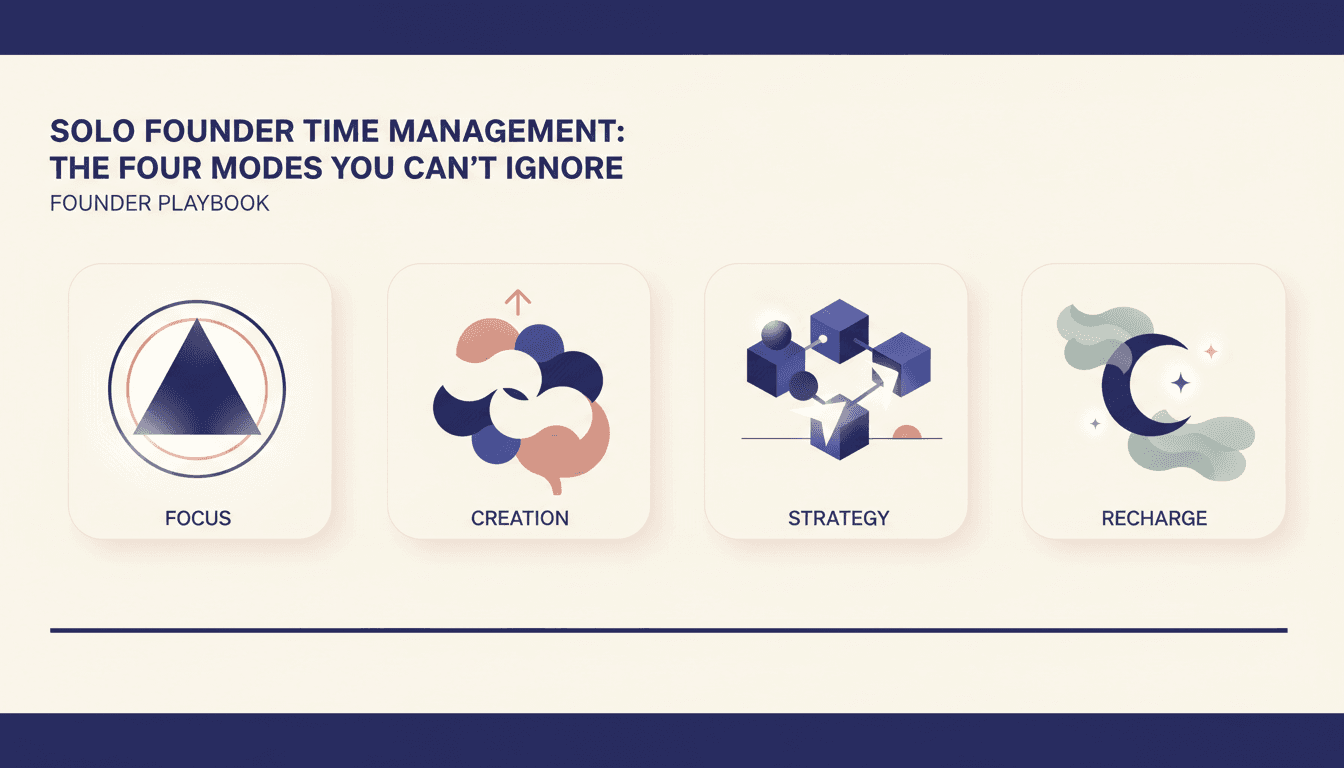
The average solo founder spends 62% of their time on reactive work according to a UC Berkeley study of early-stage startups. This isn't inefficiency—it's a structural failure to separate four irreconcilable time modes. Your week contains precisely 168 hours. The founders who 10X that time don't work more; they separate creation from optimization, connection from recovery with surgical precision.
Cal Newport's concept of "time blocking" fails founders because it assumes all blocks are created equal. A 90-minute block for coding isn't interchangeable with a 90-minute block for investor calls. Your brain doesn't reset between tasks like a factory switching product lines. Stanford research confirms context shifts between dissimilar tasks cause up to 40% cognitive overhead.
Creation Mode: Where You Build the Thing
This is the only mode that directly creates enterprise value. Characteristics:
- Duration: Minimum 3-hour blocks, ideally morning sessions when prefrontal cortex resources are highest (per the University of Michigan's chronobiology studies)
- Environment: Physical or digital isolation—zero notifications, often literal "do not disturb" signs
- Tools: Code editors, design tools, or legal pads—not email clients or Slack
- Metrics: Lines of code, product features shipped, or pages written—not "tasks completed"
Founders averaging less than 15 weekly creation hours stall at idea stage. Track this in Lebenmaster as a non-negotiable KPI.
Optimization Mode: Systems Over Willpower
This is where you build the machine that builds the thing. Common failures:
- Mistaking optimization for creation (refactoring code isn't shipping features)
- Allowing it to consume creation time (the "just one more tweak" trap)
- Key activities:
- Automating repetitive tasks (Zapier workflows, CLI scripts)
- Eliminating single points of failure (documentation, backup hires)
- Reducing decision fatigue (meal prep, outfit systems)
Goldratt's Theory of Constraints applies here: optimize only the bottleneck. If customer acquisition is your constraint, a perfect accounting system is waste.
Connection Mode: The Social Engine
Harvard Business School tracked 724 founders for five years. Those who allocated at least 20% of time to high-value connections raised 3.2X more capital and pivoted faster. The trap: letting "networking" become unstructured socializing.
- High-value connection examples:
- Investor updates with specific asks
- Customer interviews with structured scripts
- Mentor sessions focused on one bottleneck
- Low-value connection red flags:
- "Catching up" with no agenda
- Conferences without pre-booked meetings
- Social media "engagement" as a KPI
Recovery Mode: The Founder's Hidden Lever
Anders Ericsson's research on elite performers shows deliberate rest isn't optional—it's what enables the other three modes. Founders who skip recovery:
- Make 37% worse decisions under stress (University of Pennsylvania)
- Take 50% longer to solve complex problems (MIT)
- Experience 2.1X higher burnout rates (Mayo Clinic)
True recovery isn't passive. It requires:
- Physical: Sleep tracking (Oura Ring data beats guesses)
- Mental: Digital sundowning (blue light filters aren't enough—try grayscale mode)
- Emotional: Scheduled "worry time" to contain anxiety
Tactical Example: A Tuesday That Doesn't Fail
Bad Founder Tuesday:
- 9:00 AM: Check email → context shift into reaction mode
- 10:30 AM: "Quick" investor call → derails deep work
- 1:00 PM: Refactor codebase → optimization masquerading as creation
- 3:00 PM: "Networking" coffee → no agenda, no follow-up
Lebenmaster-powered Tuesday:
- 6:30–9:30 AM: Creation (shipping checkout flow) → tracked as output, not hours
- 10:00–11:00 AM: Optimization (automated payroll) → bottleneck-focused
- 2:00–3:00 PM: Connection (pre-scripted user interview) → recorded and transcribed
- 6:00 PM: Recovery (cold plunge + no screens after 8pm) → scheduled like a meeting
The founder's advantage isn't more hours—it's sharper separation between modes. Tools like Lebenmaster enforce these boundaries when willpower falters. Your calendar doesn't lie: if you can't label each block as one of the four modes, you're gambling with time.
A note on product references — Lebenmaster evolves continuously in response to user feedback and market conditions. Features described in this article may already have changed, been renamed, or been deprecated. Availability of specific capabilities depends on your region, subscription tier, and platform. For the current experience, start a free trial.