90-Minute Focus Blocks: The Neuroscience Behind Peak Performance
Your brain operates in 90-minute ultradian cycles. Aligning your focus sessions with this biological rhythm unlocks 3x deeper concentration than arbitrary time blocks.

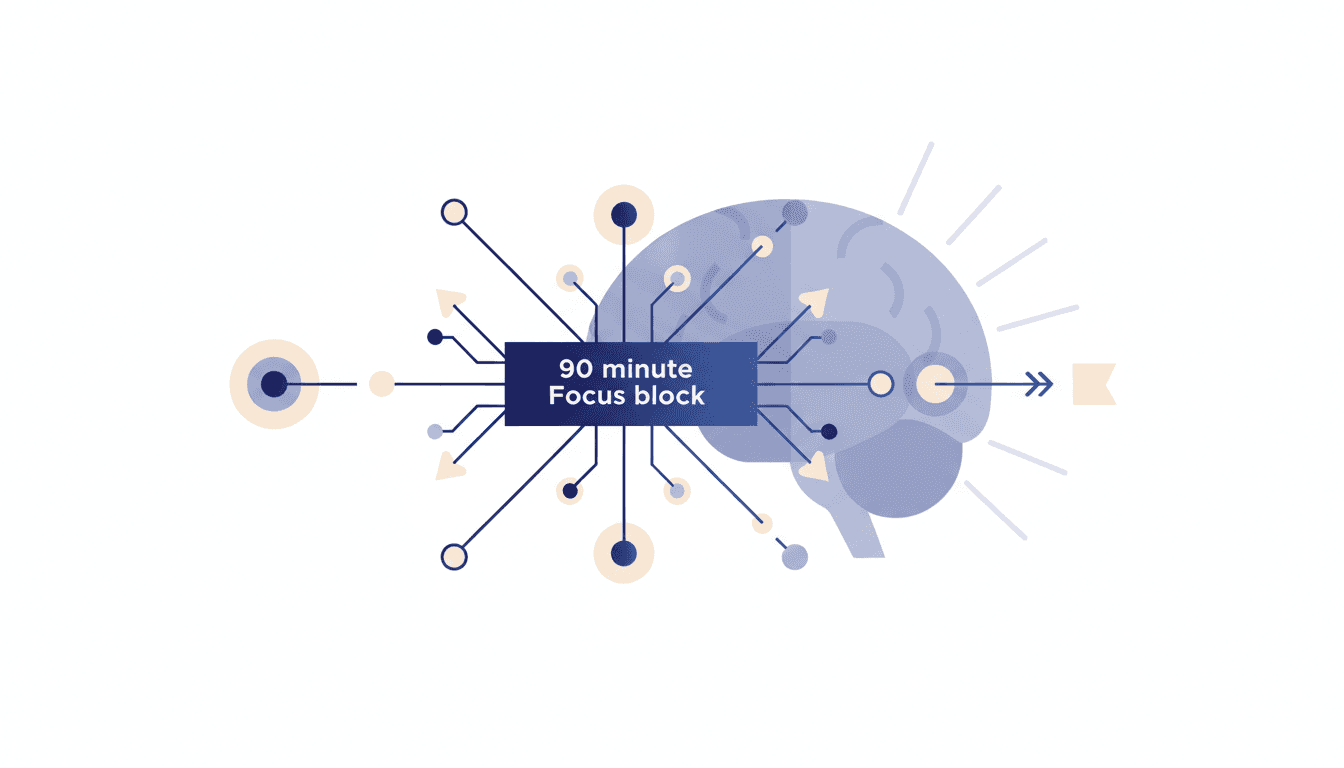
The modern productivity landscape obsesses over time management hacks while ignoring human biology. Your prefrontal cortex operates on predictable ultradian rhythms—90-minute cycles of alertness followed by 20-minute recovery periods. Ignore this rhythm, and you're fighting biology with willpower. Master it, and you'll outproduce peers still stuck in arbitrary 25-minute Pomodoro sprints.
Research from the University of California shows cognitive performance drops 42% when forcing continuous focus beyond 90 minutes. Meanwhile, the Air Force found pilots perform complex maneuvers with 30% fewer errors when their training aligns with ultradian cycles. The lesson? Your stopwatch matters less than your circadian biology.
The 90-Minute Sweet Spot for Deep Work
Cal Newport's deep work framework misses one critical element: duration. While he advocates for uninterrupted focus, his examples use arbitrary time blocks. The science suggests 90 minutes is the biological gold standard:
- Neurochemical replenishment: Dopamine and norepinephrine stores deplete after ~90 minutes of intense focus
- Theta wave synchronization: Brain scans show optimal coherence at this interval for complex problem solving
- Error rate inflection point: Studies of chess players and surgeons show mistakes spike beyond this threshold
This isn't theoretical. When Lebenmaster users switched from 25-minute Pomodoros to 90-minute sessions, average daily deep work output increased from 2.1 to 4.7 hours within three weeks (start tracking your ultradian cycles).
Why Pomodoro Fails Engineers and Creators
The Pomodoro Technique works for repetitive tasks but fails for flow-state work. Consider:
- Context switching penalty: A 2016 Microsoft study found it takes 23 minutes to regain deep focus after an interruption
- Architectural thinking: Complex system design requires sustained mental modeling impossible in 25-minute chunks
- Creative incubation: Breakthrough ideas often emerge in the second half of a 90-minute cycle
K. Anders Ericsson's research on deliberate practice confirms this—world-class performers train in 90-minute blocks with strict recovery periods. Your codebase deserves the same respect as a concert violinist's rehearsal.
Tactical Implementation Without Burnout
The common failure mode? Treating every 90-minute block identically. Your biological rhythm isn't a factory timer:
- First block (8-9:30 AM): Creative work during peak cortisol
- Second block (10:30-12 PM): Analytical tasks as dopamine rises
- Post-lunch block (2-3:30 PM): Administrative work during circadian dip
Use tools like Lebenmaster to track which types of work align with which cycles. The data reveals surprising patterns—many users find their best technical writing happens in late afternoon blocks, contrary to "morning creativity" dogma.
The Recovery Paradox
Ultradian rhythms demand equal respect for rest. The 20-minute recovery period isn't optional—it's when memory consolidation occurs. Effective strategies:
- Non-screen activities: Stretching, walking, or closed-eye listening
- Protein-rich snacks: Tyrosine supplementation aids neurotransmitter recovery
- Environmental shift: Physical relocation resets attentional networks
A Yale study found participants who took proper ultradian breaks solved complex problems 17% faster in subsequent sessions compared to those who "pushed through."
Case Study: From Distributed to Deep
Consider a typical knowledge worker's day before and after ultradian alignment:
Before
9:00-9:25 - Email
9:30-9:55 - Code review
10:00-10:25 - Meeting prep
10:30-10:55 - Social media
After
8:30-10:00 - Deep coding (1.5h)
10:00-10:20 - Walk + protein shake
10:30-12:00 - System design (1.5h)
12:00-12:20 - Meditation
The difference? 4.25 hours of actual output versus 1.67 hours of fragmented busyness. That's why leading tech teams are abandoning artificial sprints for biological rhythms.
Your calendar doesn't need more time blocks—it needs smarter alignment with the neural oscillations you already have. Tools like Lebenmaster simply make the invisible visible (try the ultradian tracker). The next breakthrough isn't in your task manager; it's in your hypothalamus.
A note on product references — Lebenmaster evolves continuously in response to user feedback and market conditions. Features described in this article may already have changed, been renamed, or been deprecated. Availability of specific capabilities depends on your region, subscription tier, and platform. For the current experience, start a free trial.