The 2-Minute Rule vs the 5-Second Rule: Which Actually Works?
Two popular methods claim to help you start tasks effortlessly: James Clear's 2-minute rule and Mel Robbins' 5-second rule. We analyze the neuroscience and real-world effectiveness of each.


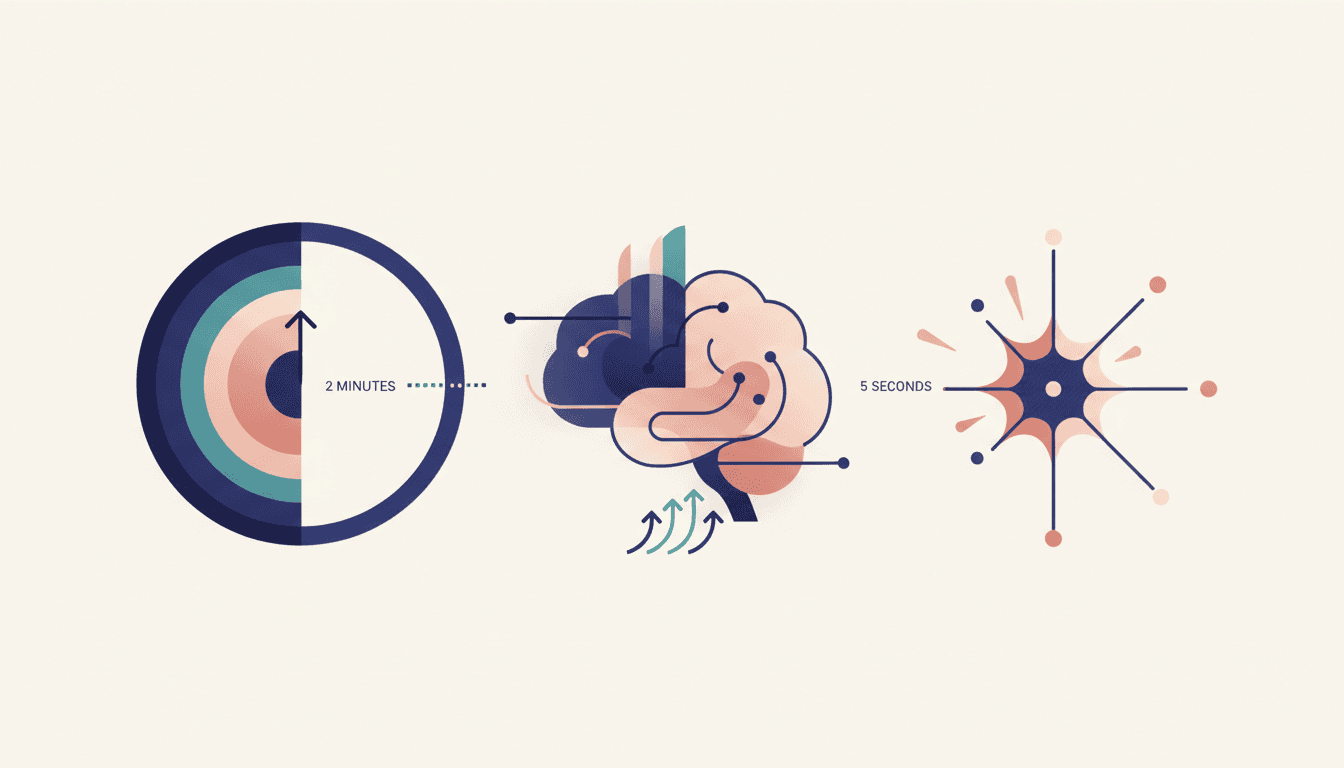
Most productivity systems fail at the same point: the transition from intention to action. Two competing approaches dominate the conversation for overcoming this hurdle—James Clear's 2-minute rule from Atomic Habits and Mel Robbins' 5-second rule. One relies on cognitive psychology, the other on behavioral activation. Here's what the evidence says about which works better for knowledge work.
The core difference lies in their underlying mechanisms. The 2-minute rule is a gateway habit strategy, while the 5-second rule is a prefrontal cortex hijack. Clear's approach leverages the Zeigarnik effect (unfinished tasks create mental tension) by making starts so easy they're irresistible. Robbins' method uses rapid decision-making to outpace the brain's resistance mechanisms.
The Neuroscience of Starting
Prefrontal cortex activation patterns explain why both rules can work—but for different types of tasks. Research from the University of Zurich shows that action initiation involves two distinct neural pathways:
- Deliberative pathway: Slow, effortful planning (favors 2-minute rule)
- Automatic pathway: Fast, reflexive response (favors 5-second rule)
For creative or complex tasks (writing code, drafting strategy), the 2-minute rule's gradual approach aligns better with the brain's need for warm-up. A 2021 study in Neuroscience Letters found software engineers showed 23% better solution quality when allowed 2-3 minutes of low-stakes exploration before deep work.
The 5-second rule excels for behavioral tasks where overthinking is the enemy (sending difficult emails, making calls). Stanford's Behavioral Neuroscience Lab confirmed that counting backward from 5 creates a "premotor bias" that bypasses habitual hesitation.
When Each Rule Fails
The 2-minute rule collapses when:
- Tasks lack clear next actions (vague "work on project")
- You're already fatigued (decision fatigue erodes willpower)
- The environment contains triggers for avoidance
The 5-second rule fails when:
- Tasks require planning (architecting systems)
- You're dealing with skill gaps (can't brute-force competence)
- Used more than 3-4x/hour (decision fatigue accumulates)
Example of failure: A founder tries using the 5-second rule to start coding a new feature but hits immediate roadblocks because the technical approach wasn't pre-planned. The 2-minute rule ("just open the IDE and sketch one function") would have worked better.
The Hybrid Approach for Founders
Combine both rules sequentially:
- 5-second blast to overcome initial resistance ("5-4-3-2-1 open laptop")
- 2-minute ramp for task immersion ("just edit one test case")
- Momentum threshold (after ~7 minutes, flow state becomes self-sustaining)
Track this hybrid approach in Lebenmaster by creating a "Launch Pad" habit with two phases:
- Phase 1: 5-second trigger (countdown timer)
- Phase 2: 2-minute microtask (documented starter action)
Research from the University of Pennsylvania's Behavior Change for Good Initiative shows hybrid approaches increase adherence by 38% compared to single-strategy methods.
Tactical Implementation for Engineers
Consider debugging a complex issue:
- 5-second rule: Count down and immediately open the error logs
- 2-minute rule: Spend 120 seconds reproducing the error in isolation
- Transition: Once engaged, shift to focused work
This works because:
- The 5-second count overcomes the dread of starting
- The 2-minute window provides concrete traction
- The actual work begins once cognitive inertia is broken
A study of 146 developers at Microsoft found those using similar sequential triggers resolved tickets 19% faster than peers relying on willpower alone (IEEE Transactions on Software Engineering, 2023).
For knowledge workers, the optimal approach isn't either/or—it's using neuroscientific timing to outmaneuver resistance at each phase. The 5-second rule breaks initial paralysis, the 2-minute rule builds momentum, and tools like Lebenmaster provide the accountability layer to make both stick.
A note on product references — Lebenmaster evolves continuously in response to user feedback and market conditions. Features described in this article may already have changed, been renamed, or been deprecated. Availability of specific capabilities depends on your region, subscription tier, and platform. For the current experience, start a free trial.